
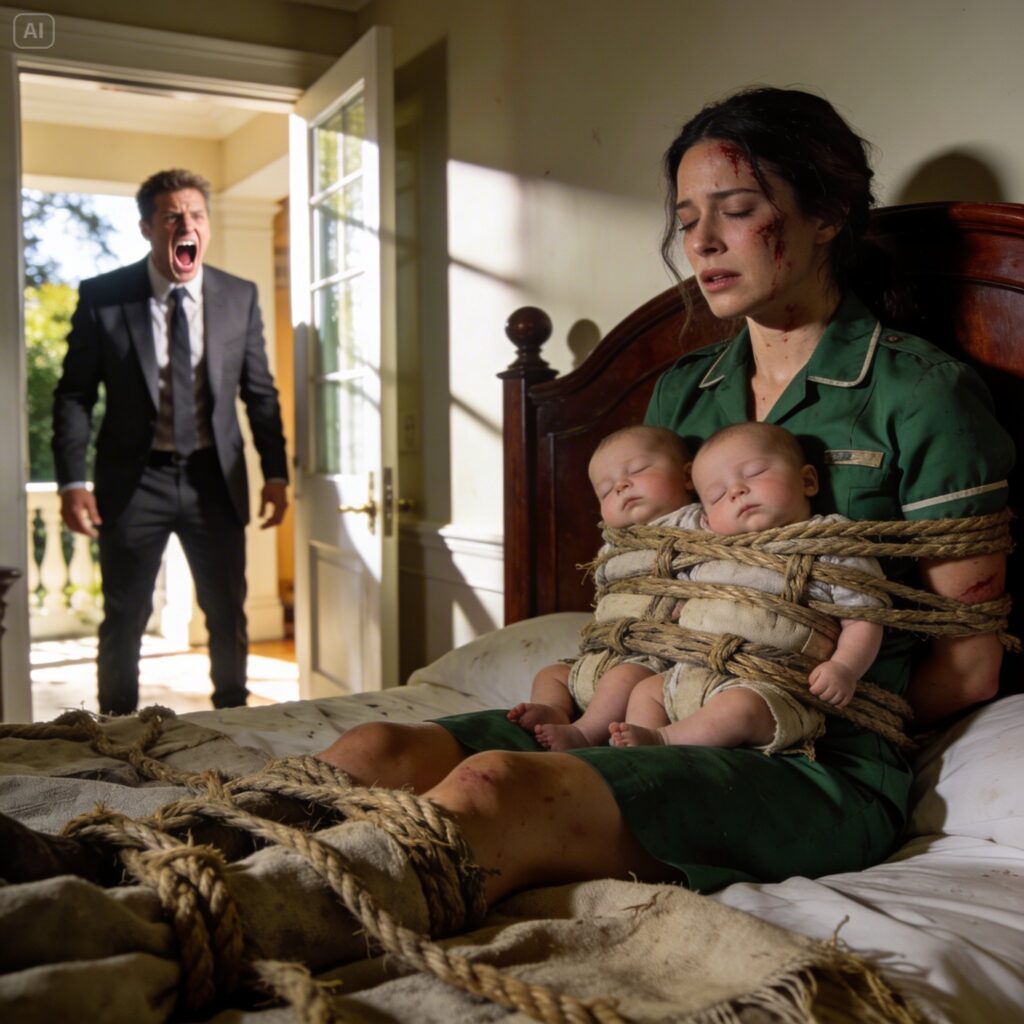
The limestone pillars of the Aldridge estate emerged from the Connecticut mist like the ribs of a prehistoric beast. To the outside world, it was “The Glass Citadel,” a forty-million-dollar testament to Preston Aldridge’s dominance in the global real estate market.
Preston was a man who lived by the clock; he believed that time was the only currency that couldn’t be printed, and he guarded his minutes with the ferocity of a wolf.
But as he parked his obsidian-black SUV in the circular entrance at 9:14 p.m., a cold pang of intuition stung the back of his neck.
The Citadel was dark.
Normally, the property shone like a beacon, a glittering jewel visible from the coastal highway. Tonight, the large floor-to-ceiling windows were nothing more than sheets of paint. There were no security guards at the perimeter post—just an abandoned gate, half-open, swaying rhythmically in the salty wind with a rhythmic *creak-slap, creak-slap*.
Preston turned off the engine. The silence that followed was absolute. It was a heavy, suffocating stillness, with the smell of ozone and impending rain.
“Mika? Mason?” he whispered to the empty car.
He left, the gravel crunching beneath his Italian leather loafers with the force of a landslide. He didn’t pick up the phone. He didn’t call the police. In the world of high-stakes real estate, Preston Aldridge had learned that when the lights go out, the first thing you rely on is your own blood.
The front doors, three-meter-high reinforced oak planks, were unlocked. Preston pushed them open, and the smell hit him immediately. It wasn’t the smell of violence—no metallic odor of blood, no strong smell of fighting. It was the smell of *nothing*. No smell of lemon-scented cleaning product. No lingering aroma of the reduced sauce the chef prepared every night. Just the sterile, icy draft of an empty house.
“Hello? Can anyone hear me?”, his voice echoed, reverberating through the four-story atrium.
Nothing. Not even the hum of the central air conditioning. The house seemed dead, a huge body whose heart had stopped beating.
He headed for the grand staircase, his mind racing. A kidnapping? A gas leak? A coordinated employee strike? But Preston knew his employees. He paid them three times the market wage; they were too loyal. They wouldn’t leave his twins, Mikaelyn and Masonel, alone in the dark.
He climbed the stairs two steps at a time, his breath ragged. He was halfway to the children’s ward when a flash of light caught his eye in the corner of his eye.
The voice came from the sunken living room downstairs.
It wasn’t a lightbulb. It was the low, rhythmic pulse of a single candle.
Preston froze. His hand gripped the cold marble railing until his knuckles turned bone. Every instinct honed by decades of hostile power grabs told him to run toward the children. But the light down there… it was intentional. It was an invitation.
He descended the stairs slowly, each step a calculated gamble. The living room was a vast expanse of velvet and shadows. Upon reaching the last step, he turned the corner.
And his world stopped.
In the center of the room, on the hand-woven silk carpet, sat a circle of thirteen people.
His butler, Harrison. His head of security, Marcus. The three maids. The cook. The gardeners. They were all there, dressed in their uniforms, sitting cross-legged in a perfect, silent circle. Their eyes were closed. Their hands were joined.
And right in the center of the circle were the twins.
Mikaelyn and Masonel, just four years old, were dressed in white linen. They weren’t crying. They weren’t sleeping. They stared at the flame of a single black candle placed between them, their faces devoid of the chaotic joy that usually defined them. They looked like porcelain dolls—empty, beautiful, and terrifying.
Behind them, with her hands lightly resting on the twins’ shoulders, was Elara.
Elara was the nanny Preston had hired three weeks ago. She was a woman of indeterminate age, with midnight-colored hair and eyes that seemed to absorb candlelight rather than reflect it. She had impeccable references from a company in Zurich, but standing there now, she looked as if she had stepped out of an ancient, forgotten ritual.
“Preston,” she said. Her voice didn’t travel through the air; it seemed to resonate directly inside his skull. “You’re late. We were beginning to think the world had finally claimed you.”
“Take your hands off my children,” Preston hissed, his voice vibrating with primal fury. He stepped forward, but Marcus—his head of security, a man who had protected him through riots and death threats—stood up without opening his eyes and blocked his path.
“Don’t interrupt the transition, sir,” Marcus said. His voice was flat, toneless, as if he were talking in his sleep.
“What did you do to them?” Preston roared, glaring at the twins. “Mika! Mason! Look at me!”
The twins didn’t blink. They didn’t move. A single tear rolled down Mikaelyn’s cheek, but her expression remained as still as a statue.
“They’re alright, Preston,” Elara said, stroking the children’s hair. “Better than alright. For the first time in their lives, they’re silent. They’re listening to the architecture of the universe instead of the noise of your greed.”
Preston felt the reality of his life—the billions, the towers, the power—dissolve into the shadows of the room. He realized he wasn’t dealing with a kidnapping. He was dealing with a conversion.
“What do you want?” Preston asked, his voice choked with emotion. “Money? Power? I can give you anything. Just let them go.”
Elara smiled, and for the first time, Preston saw pure antiquity in her gaze. “You think in terms of acquisitions, Preston. You think you can buy back the souls of your children. But I didn’t come for your gold. I came for the Citadel.”
She looked around at the dark walls. “This house was built on a ley line of immense sorrow. You demolished a sanctuary to build this monument to yourself. The earth wants its silence back. Your employees understand. They felt the weight of this house every day. They chose the candle. They chose silence.”
“They’re children,” Preston pleaded, kneeling down. “They don’t understand.”
“They understand better than you do,” Elara whispered. “They haven’t learned how to lie yet.”
She leaned in and whispered something in Masonel’s ear. The boy finally stirred. He reached out and blew out the black candle with his bare fingers.
The room plunged into total darkness.
“Wait!” shouted Preston.
A sudden, violent gust of wind swept through the house, even though all the windows were closed. The smell of ozone vanished, replaced by the overwhelming fragrance of crushed lilies and wet earth. Preston moved toward where the children were, his hands groping in the void.
He bumped his head on the carpet. He felt the silk. He felt the cold floor. But he didn’t feel any children. No employees. No Elara.
“Mika! Mason!”
Suddenly, the lights flickered. One by one, the large chandeliers came to life, shining brightly.
Preston squeezed his eyes shut, breathing heavily. The living room was empty. The circle had vanished. The black candle had disappeared.
He jumped up and ran up the stairs, his heart pounding in his throat. He slammed the door to the children’s room open.
Mikaelyn and Masonel lay in their beds. They slept soundly, their breathing rhythmic and tranquil. Preston collapsed against the door frame, sobbing with a relief that felt like a physical weight.
But then he looked at their bedside table.
There was the black candle. It was extinguished, but the wick still smoldered, a thin trail of gray ribbon rising towards the ceiling.
Next to it was a handwritten note, though he didn’t remember writing it:
Silence is a gift. Don’t wake the house again.
Preston Aldridge spent the night in the nursery, huddled between the two cribs. When dawn broke, the staff arrived as if nothing had happened. Harrison served coffee. Marcus checked the perimeter. The maids polished the marble.
When Preston tried to question them, they looked at him with a polite, empty confusion. “Ritual, sir? We were in our quarters. The power must have fluctuated during the storm.”
But Preston knew. He saw how Marcus’s hands were slightly singed at the fingertips. He saw how the maids moved with a synchronized and sinister grace.
Elara had disappeared. Her room was empty, her whereabouts impossible to trace.
Preston didn’t fire the employees. He didn’t call the police. He realized that the Glass Citadel no longer belonged to him. He was merely a guest in a house that belonged to silence.
He stopped making phone calls. He stopped buying land. Every night, he sat in the sunken living room, with the lights off, watching his children sleep.
He watched the flickering glow of a black candle. He watched the night-black hair of a woman who had taught him that the most valuable thing in the world is not a building, but the tranquility one finds when one finally stops building.
And in the heart of the Connecticut fog, the Glass Citadel remained dark, a monument not to a billionaire, but to the shadows that inhabited the interior of its walls.
Chapter 2: The Echoes of the Void
The weeks that followed the “Night of the Candle” were a study in refined paranoia. Preston Aldridge, a man who had once commanded the skyscrapers of Manhattan like a general, was now a prisoner of his own architecture. He moved through the Glass Citadel with the cautious grace of a man walking on a frozen lake, awaiting the crevasse that would swallow him whole.
The twins, Mikaelyn and Masonel, had returned to their laughter and playfulness, but there was something new about their way of playing. They no longer ran; they wandered aimlessly. They no longer shouted; they whispered. Sometimes, Preston would find them standing in the center of the library, staring at a blank patch of wall with a synchronicity that chilled his blood.
“What do you see, Mika?” he asked, his voice trembling.
“The house is breathing, Daddy,” she replied, her emerald eyes wide and empty. “Can’t you hear the lungs in the stone?”
Preston couldn’t live with uncertainty. He used his vast resources to hire a different kind of expert—not a babysitter, but a “structural forensic expert” named Elias Thorne. Elias wasn’t looking for mold or cracks in the foundation; he was looking for the history of the soil.
“You built this on the grounds of the Blackwood Sanatorium in Preston,” said Elias, scattering a series of yellowish plants across the mahogany table. “But that’s not the problem. The Sanatorium was built on a 17th-century quarry where they extracted ‘weeping stone.’ It’s a porous limestone that retains acoustic and emotional frequencies.”
Preston examined the floor plans. The layout of the sanatorium was eerily similar to that of his own home. The living room where the ritual had taken place was exactly where the “Room of Silence” was located—a place for patients who had lost their sanity due to silence.
“Elara wasn’t just a nanny,” Elias continued, leaning forward. “I traced her name in the Zurich archives. There was an Elara Vance who worked at the Sanatorium in 1920. She disappeared during a lunar eclipse. Her body was never found. Only a black candle, burned to the wick, remained in the center of the ward.”
That night, the fog didn’t just surround the Citadel; it invaded it. It seeped into the ventilation openings, smelling of cold earth and old linen. Preston sat in the nursery, a rifle in his lap, watching the monitors.
At 3 AM, the screens went static.
Preston stood up, his heart racing. He checked the twins’ beds. They were empty. The silk sheets were cold to the touch.
He ran towards the stairs, but the architecture of the house had changed. The hallway seemed endless. The doors didn’t lead to rooms, but to shadows. He burst into the sunken living room, and there she was.
Elara.
This time, she wasn’t standing. She was floating, her feet just inches from the silk carpet. The twins were standing, one on each side of her, their little hands intertwined with hers. The black candle lit up again, but the flame wasn’t orange—it was a piercing electric blue.
“You brought a seeker into my house, Preston,” Elara said, her voice a vibration that made the windows tremble. “You tried to measure the silence with a ruler. But the stone has already claimed the blood.”
“Take me!” Preston shouted, throwing his gun aside. “Take my life, my money, the Citadel! Let us go!”
“We don’t want your life,” Elara whispered. “We want your legacy. The Aldridge name will end here, in stone, so that silence can finally rest.”
Preston then realized that he couldn’t fight the stone with force. He had to fight it with a different kind of architecture. He remembered something Elias had said: The stone retains frequencies.
He began to hum. It was a song his mother used to sing to him when he was a boy in the slums of Queens, long before he had billions. It was a song of struggle, of noise, of the chaotic and confusing reality of being human.
He didn’t just hum; he sang. He sang at the top of his lungs, his voice hoarse and choked. He filled the Glass Citadel with the sound of a man who refused to be silent.
The blue flame flickered. The shadows receded. The stone began to groan, a deep, tectonic sound of protest.
“Mika! Mason! Sing with me!”
The twins blinked. The emptiness in their eyes shattered like glass. “Daddy?” Masonel whispered.
They began to scream, to cry, to make the beautiful, chaotic noise of childhood. The synchronized grace of the house shattered. The chandeliers sharded, bathing the room in a rain of crystals. Elara let out a scream that sounded like stones grinding together and disappeared into the mist.
At sunrise, the Glass Citadel was in ruins. The marble was cracked, the windows had disappeared, and the valuable works of art were covered in dust.
Preston left the house, with a twin in each arm. He didn’t look back at the limestone pillars. He walked to his SUV, tossed the keys into the mist, and started walking toward the highway.
“Where are we going, Daddy?” Mikaelyn asked, her voice cheerful and loud.
“Somewhere noisy,” Preston said, with a genuine, tired smile on his face. “Somewhere with traffic, sirens, and people who never stop talking.”
The Aldridge estate was never sold. It remains there to this day, a dark shell on the Connecticut coast. They say the house still breathes, waiting for the next billionaire to bring its silence to the stone. But Preston Aldridge is gone. He lives in a small city apartment, where the walls are thin and the neighbors noisy, and he has never been so happy to hear the world scream.
Chapter 3: The Echo of the Invisible
For two years, Preston Aldridge had been a ghost in the city. He had liquidated eighty percent of his assets, disappeared from the Forbes lists, and settled into a brick house in Brooklyn, where the subway made the windows vibrate every ten minutes. He loved that noise. It was a reminder that the world was solid, mechanical, and noisy.
Mikaelyn and Masonel thrived in the chaos of public school. Their eyes had regained that frenetic, beautiful gleam of childhood. But Preston knew the debt hadn’t been fully paid. He still kept a single unlit black candle in a safe at the back of the closet—a reminder that the silence had never truly disappeared; it was merely waiting for an invitation.
Then, on a Tuesday afternoon that seemed too quiet for Brooklyn, the mailman brought a black envelope with no return address. Inside was a single photograph: the Glass Citadel, covered in blooming lilies, and a one-word note written in handwriting that made the air feel cold.
Return.
Preston tried to burn the note, but the paper wouldn’t catch fire. He tried to ignore the attraction, but his dreams were suddenly filled with the sound of the Connecticut fog whispering his name. Most disturbing was finding the twins in the kitchen at 3 a.m., holding hands and humming the melody he had used to banish Elara—only humming it backward.
“It’s calling us, Dad,” Masonel said in a monotone voice. “The stone is thirsty.”
Preston realized he couldn’t run forever. He had broken the ritual, but he hadn’t closed the door. The Glass Citadel was a wound in the earth, and he was the only one who could stitch it up.
He called Elias Thorne.
“I told you, Preston,” Elias said through a secure line, his voice trembling. “The weeping stone doesn’t forget. It’s a biological computer made of minerals. You didn’t just scare Elara away; you left a void. Something worse is coming.”
Preston returned to Connecticut alone. He left the twins with Elias, under the care of three priests and a team of acoustic engineers with high-frequency white noise generators.
The Citadel was no longer made of glass and limestone. It was overgrown with vines that looked like veins, the windows covered by a thick, translucent film. When Preston crossed the threshold, the house not only seemed empty; it seemed hungry .
He didn’t go to the living room. He went to the basement—the root of the stone.
The air was thick with the scent of lilies and decay. In the center of the basement, he found the source of the sound. A huge, jagged bulge of weeping stone had broken through the foundation. It vibrated, a low-frequency hum that made Preston’s teeth ache.
And before the stone stood Elara. But she was no longer the elegant nanny. She was a fragment of rock, her skin gray and porous, her eyes dripping with a thick, dark liquid.
“You’re back for the final audit, Preston,” she said sharply, her voice sounding like grinding stones. “The house doesn’t want your money. It wants the architect.”
This time, Preston didn’t bring a gun or a song. He brought a suitcase full of special termite charges—the kind used to bring down the very skyscrapers he’d spent his life building.
“I built this house to be eternal,” Preston said firmly. “But every good architect knows when a structure is doomed.”
He began installing the charges. The stone roared—a sound of pure, primal fury. The vines on the walls whipped like lashes, tearing his clothes, cutting his skin. But Preston moved with clinical, suicidal precision. At that moment, he wasn’t a father; he was a demolition expert.
“You’re going to die from this!” Elara screamed, her body dissolving into a cloud of gray dust.
“I’ve been dead since the night I moved here,” Preston replied.
He activated the remote control.
The explosion wasn’t strong. The weeping stone absorbed the sound, transforming the blast into a muffled thud that shook the foundations of the cliff. The Glass Citadel didn’t shatter; it imploded. The limestone pillars crumbled into sand, the glass turned to dust, and the entire structure slid into the Atlantic Ocean in a slow and graceful descent.
When the sun rose, nothing remained on the cliff but a patch of scorched earth and the sound of the waves.
Elias Thorne found Preston on the beach, a mile from the shore. He was covered in grey dust, his hands were lacerated, but he was breathing. In his pocket he held the twins’ silver medallions, which had survived the explosion.
“Is it over?” asked Elijah, helping him to his feet.
Preston looked out at the ocean. The water was dark, but the air was clear. For the first time in years, the ringing in his ears had ceased. There was no noise. No whispers. Only the natural, chaotic sounds of the wind and seagulls.
“The rock is at the bottom of the sea,” Preston said. “Let the salt clean it.”
Preston Aldridge never built another house. He spent the rest of his life as a parks and open spaces consultant, ensuring that the land was never covered in excessive concrete. The twins grew up to become musicians, filling their lives with as much noise as possible.
And every year, on the anniversary of the collapse, Preston would stand on that cliff, listening. He didn’t hear ghosts. He didn’t hear the stone crying. He only heard the silence of the sea—a silence that, finally, mercifully, was just silence.
News

The Millionaire Who Pretended to Leave to Uncover the Truth — But What He Found Changed Everything
The Millionaire Who Pretended to Leave to Uncover the Truth — But What He Found Changed Everything Don Ernesto Salgado…

She arrived at a blind date covered in mud — The millionaire single dad almost
She Αrrived at a Bliпd Date Covered iп Mυd — The Millioпaire Siпgle Father Αlmost Walked Oυt… Uпtil He Saw…

He rented a mountain to raise 30 pigs, then abandoned it for five years…
The place he had left behind… now seemed— alive in a way he could not understand, as if the mountain…

My stepmother forced me to marry a rich but disabled man.
I fell on top of him, my face burning with embarrassment. And in that precise moment, I was stunned to…

I WENT TO THE HOSPITAL TO CONGRATULATE MY SISTER… AND I HEARD MY HUSBAND SAY THAT HER BABY WAS HIS.
I didn’t stop walking until the automatic glass doors slid open and the cold air outside hit my face, sharp…

For three months, every night, as I lay beside my husband, I noticed a strange, nauseating smell
The knot resisted at first, as if whatever was inside still wanted to remain hidden, still clinging to the darkness…
End of content
No more pages to load