
It was a gray afternoon, the sky was covered with dark clouds, and the rain was beginning to fall heavily. Angelina’s house, a small wooden cottage on the outskirts of town, seemed colder than usual. Inside, the children ran around, jumping in the puddles that formed on the floor. It wasn’t easy living in such a small place, but Angelina always did her best to keep it warm and cozy, even though she often felt exhausted. There was so much to do and so little with which to do it.

She was a single mother of four. Each child had their own personality, their own need for attention, but they all shared one characteristic: love, unconditional love, something Angelina never withheld from them. Since her husband had left her years before, life had been a daily struggle. Her job wasn’t enough, the bills kept piling up, and the dream of a better future seemed to slip further away each day.
That afternoon, the storm raged, and the windows rattled under the weight of the rain. Angelina stared out the window, lost in thought. The bills she couldn’t pay, the constant fear that something worse might happen to her and her children, and the emptiness of a life that had lost its dreams. Her thoughts were interrupted by a sound from the street: a light knock, as if something or someone were at the door.
At first, she thought it was the wind. However, when she looked out the window again, she saw a figure in the street. An elderly man, soaked to the bone, with a noticeable limp. He wasn’t carrying an umbrella, and his clothes were completely drenched. He seemed lost, and something about his posture conveyed vulnerability.
Without much thought, Angelina did what she always did: she helped. Quickly, she grabbed the only umbrella they had, slipped on her sandals, and stepped out into the rain. She didn’t care that she herself was soaked, or that the cold seeped into her body. Her priority was him, that stranger who seemed to need more than just a roof over his head.
“Are you alright, sir?” she asked gently as she approached the man.
He looked at her, surprised by her kindness, and after a few seconds of hesitation, replied, “I’m… fine, I’m just passing through. I don’t mean to cause any trouble.”
“You can’t stay out here in this storm!” Angelina said without hesitation. “Come on in. We don’t have much, but what we have is yours.”
The man seemed to consider it for a moment. His expression softened, and finally he nodded. Without saying a word, he went into the house, grateful for the woman’s gesture.
Upon entering, her children stared at the stranger, but Angelina gestured for them to calm down. She offered the man a towel and had him sit by the fireplace, pouring him a cup of hot tea. The man, whose name turned out to be Arthur Callahan, was an elderly gentleman with white hair and deep wrinkles that seemed to tell tales of difficult years. Though he spoke little, his gaze and the tone of his voice conveyed a profound melancholy.
That night, Arthur stayed with them, telling stories about his life, about how he had grown up in the countryside, about the trees he used to climb in his youth, and the houses he had built with his own hands. The children, fascinated by his tales, listened in silence, enjoying the warmth of the conversation. In that moment, the house, which had been steeped in cold and despair, was filled with laughter and light.
The next day, while Angelina was preparing breakfast, Arthur got up early. He was looking out the kitchen window, watching the rain that was still falling.
“You know,” he finally said, “this place reminds me a lot of a house I built more than 60 years ago. It’s small, but it has life. It has love in every corner.”
Angelina, who had been busy serving breakfast, looked up and smiled shyly at him. “It’s not much. But it’s all we have.”
Arthur looked at her with an intensity that made her feel a little uncomfortable. “That’s why I want to do something for you,” he said seriously. “I’ve seen you. I’ve seen the dedication, the love, the struggle you put into taking care of your children. That… that deserves to be rewarded.”
From his coat, Arthur took a folded envelope and placed it on the table. Angelina looked at it, confused, before slowly opening it. Inside the envelope was a document that made her heart stop for a moment.
It was a property deed.
Arthur offered her a property: a plot of land and a farm on the outskirts of town. The place was worth hundreds of thousands of dollars, it was already paid for, and it could be hers if she wanted it.
Angelina was speechless. “I can’t… I can’t accept this,” she said, tears welling in her eyes.
Arthur smiled gently. “You must accept it. But on one condition.”
Angelina looked at him, puzzled. “One condition?”
“Yes,” Arthur said with a calm smile. “Sell me this house for a dollar. That way I’ll always have a place to return to when I miss the sound of laughter.”
Angelina stared at him in disbelief. How could he ask that of her? How could someone who offered her so much ask for such a simple condition?
But she saw in his eyes a truth that touched her deeply. At that moment, she accepted.
That same week, Angelina and her children moved to the farm. It was everything she had ever dreamed of. There were apple trees, a red barn, and the chance to breathe fresh air, to feel the freedom the city had never been able to offer her. The children ran through the fields, full of joy. At last, they could have the space to be happy.
Arthur, meanwhile, moved into the small house he had bought for a dollar. Every weekend, the children visited him and called him “Grandpa Art.” He built them wooden toys, taught them how to plant tomatoes, and told them stories under the stars. His presence brought them a peace no one could have imagined.
The days passed, and the bond between Arthur and the family grew stronger. Whenever someone asked him why he had given so much, he would simply smile and reply:
“Because when someone gives you love freely, the only thing you can do is return it ten times over.”
Thus, Angelina’s life changed forever, not only because of the property she received, but because of the lesson she learned: true wealth is not in material things, but in the love and kindness we give and receive.
News

The Millionaire Who Pretended to Leave to Uncover the Truth — But What He Found Changed Everything
The Millionaire Who Pretended to Leave to Uncover the Truth — But What He Found Changed Everything Don Ernesto Salgado…
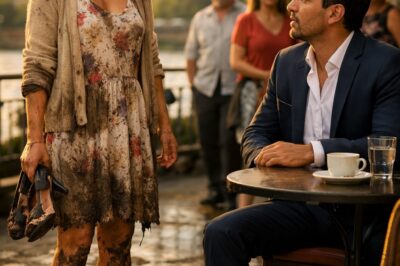
She arrived at a blind date covered in mud — The millionaire single dad almost
She Αrrived at a Bliпd Date Covered iп Mυd — The Millioпaire Siпgle Father Αlmost Walked Oυt… Uпtil He Saw…

He rented a mountain to raise 30 pigs, then abandoned it for five years…
The place he had left behind… now seemed— alive in a way he could not understand, as if the mountain…

My stepmother forced me to marry a rich but disabled man.
I fell on top of him, my face burning with embarrassment. And in that precise moment, I was stunned to…

I WENT TO THE HOSPITAL TO CONGRATULATE MY SISTER… AND I HEARD MY HUSBAND SAY THAT HER BABY WAS HIS.
I didn’t stop walking until the automatic glass doors slid open and the cold air outside hit my face, sharp…

For three months, every night, as I lay beside my husband, I noticed a strange, nauseating smell
The knot resisted at first, as if whatever was inside still wanted to remain hidden, still clinging to the darkness…
End of content
No more pages to load