
I’ll never forget the smell of that day, because some smells cling to your soul forever. It smelled of earth dampened by the early morning rain, of wilted marigolds, and of stale coffee, reheated time and again, the kind they serve at the little restaurant across from the town’s funeral home. Antonio’s burial was on a Saturday morning, in a remote village in the mountains of Oaxaca , where the church bells ring the same for a wedding as for a tragedy. The sky was so low and so gray it seemed as if it might collapse on us, as if even God were tired of watching what was happening down there.
I stood before the grave, dressed entirely in black, wearing a dress borrowed from my neighbor because mine no longer fit after my pregnancy. I didn’t have a penny to buy anything decent. In my arms, I held Mateo , my baby of barely six months, wrapped in a thin blanket that had already been through too many hands. With my other hand, I squeezed the cold, sweaty little hand of Lucía , my four-year-old daughter, who kept staring at the coffin as if she expected her father to get up and walk out, as he always did when he came back from the fields.
Suddenly, with that innocence that hurts more than any blow, Lucía pulled at my dress and asked me in a low voice, almost fearfully:
“Mom… is my dad going to come back when they cover the hole?”
I felt something break inside me. I opened my mouth to answer her, but no sound came out. I had a lump in my throat and my eyes were dry, not because I didn’t want to cry, but because fear had already swallowed all my tears. I hugged her tightly, as if that way I could protect her from a truth I didn’t even understand yet.
Antonio had died suddenly. An accident in the fields, they said. No one wanted to give many details. In the village, when death comes, it’s accepted and kept quiet, especially when it suits certain interests. I’d barely had time to grasp that I was left alone, with two small children and nothing that was truly mine.
Antonio’s brothers were there too. Eusebio and Ramón . Two big men, broad-shouldered, with hands dry from work and eyes as hard as stone. From the first day, they made it clear they didn’t like me. To them, I was always “the poor girl,” the one who arrived without a dowry, without land, without an important surname. They said I wasn’t good for ranch work, that I was weak, too quiet, that I had no character. Antonio always defended me, but I knew that as long as he lived, he was the only wall between them and me.
When the last shovelful of earth fell and the priest finished praying, people began to disperse. Some approached to offer their condolences with memorized phrases, others lowered their gaze, uncomfortable, as if my misfortune were contagious. It was right there, at the exit of the cemetery, that Eusebio blocked my path. He placed his heavy hand on my shoulder, squeezing a little harder than necessary.
— Carmen —she said without looking me in the eyes—, we need to talk about the inheritance.
The word sounded absurd to me, almost a mockery. Antonio owned nothing. He worked from sunrise to sunset on his father’s communal lands for a miserable wage. We lived in an old house that wasn’t ours, but “the family’s.”
—What inheritance, Eusebio? —I asked with a trembling voice, settling Mateo, who was already starting to cry from hunger.
Ramón, who was behind her lighting a cigarette, let out a short, dry laugh, the kind that bodes ill.
“Look, woman,” he said, “you used to live in the house on the old road, but that house didn’t belong to Antonio. It belonged to my father. Now that he’s dead too, we’re going to divide everything among the siblings.”
I felt the ground shift beneath my feet.
“And my children?” I asked. “And me? Where are we going to live?”
Eusebio sighed, feigning patience.
“There’s a little house up there in the mountains, near the dry stream. It’s old, yes, but it’ll do. We’ll give it to you. We’ll draw up the papers with the notary and it’ll be yours.”
“You should be grateful,” Ramón added, exhaling a puff of cigarette smoke. “Not all widows receive anything.”
I didn’t argue. I didn’t shout. I knew I had neither the strength nor the allies. I just nodded. That same night I returned to the house that in three days would cease to be my home.
The cabin was far away, almost an hour’s walk from the last dirt road. The day they took me, we went up in Eusebio’s old pickup truck. When I got out and saw it for the first time, I felt a pit in my stomach. It was an old stone structure, covered in moss, with a roof full of holes and a rotten door. There were no windows, just gaps covered with boards. The floor was damp earth, and the air smelled of neglect.
—Here it is— said Eusebio, tossing me a rusty key. —It’s yours now.
They got into the truck and drove off laughing, kicking up dust, talking about cattle and acres. I stayed there, in the middle of the woods, with my children and the silence bearing down on me like a ton of bricks.
The first night we slept on the floor. Lucía wouldn’t stop trembling. Mateo cried from hunger until he was completely exhausted. I hugged them, trying to give them a warmth I didn’t even have myself. We ate some stale bread and drank water from the stream. I looked at the sky through the holes in the roof and wondered if this was the end of our story.
The following days were the longest of my life. Hunger, cold, constant fear. I started gathering firewood, repairing the door as best I could, patching the gaps with old rags. On the third day, I felt someone watching me. I saw him clearly: a man on horseback, standing among the oak trees. He didn’t speak. He just watched. He left. He returned the next day. And the day after that. Always at dusk.
Until one Friday he approached me and spoke.
—My name is Don Aurelio —he said—. I am the owner of the ranch next door.
Her voice wasn’t threatening, but her eyes were full of worry. She told me that the house wasn’t just a ruin, that it hid something valuable, something that had caused fights and deaths many years before. If my brothers-in-law found out before I signed the papers, I could lose everything… even my life…
Part 2: That night I understood that they hadn’t given me a house… they had handed me a sentence.
And that if I didn’t uncover the secret hidden within those walls, my children and I weren’t going to get out of there alive…

That night, with a flickering candle and an old knife that had belonged to Antonio, I began searching the house, my heart pounding in my throat. Every knock on the wall made me think someone was about to appear out of nowhere. Mateo was asleep in a corner, exhausted from crying so much, and Lucía was watching me silently, as if she understood that something important was about to happen.
I banged on a wall… nothing. Another… nothing. Until, behind the old stove, the sound changed. Hollow. There, with broken nails and bleeding hands, I removed stones one by one until I found an old box, covered in dust and cobwebs. When I opened it, I felt like the world was crashing down on me.
There were gold coins, yellowed documents, ejido deeds, and a will dated 1962. Everything was clear: whoever legally owned that stone house also owned the land, water, and livestock. Everything my brothers-in-law had coveted for years… was there, hidden, waiting for someone who wasn’t afraid.
I didn’t sleep all night. I thought about running away, selling everything in secret, disappearing with my children. But then I looked at Lucía, so small and so serious, and I understood something: if I ran away, I would be running away for the rest of my life.
Two days later, my brothers-in-law returned. This time they weren’t alone. They brought a local lawyer with them, and they had that look of someone who already felt like they’d won. They banged on the door, shouting that I had no rights, that the house wasn’t mine, that I was crazy.
“Get out peacefully, Carmen,” Eusebio shouted. “Or we’re going to drag you out.”
I looked at my children. I felt fear, yes, but also something new: a strength I didn’t know I possessed. That same night, when they thought I was defeated, I set fire to the cabin. The smoke enveloped the mountain, and I escaped from behind it with my children and the documents tucked into my chest.
They chased us. I heard their voices, their threats, their plans to take my children from me, to make me disappear as if I had never existed. We hid under the roots of an old oak tree, the earth wet up to our necks. There, trembling, the frightened woman she had been all her life died. There, another was born.
At dawn, Don Aurelio found us. He didn’t ask questions. He just helped. We traveled to Oaxaca City. I registered every document with an honest notary. I fought in courts where they looked down on me. I cried many nights. I doubted. But I didn’t give up.
Six months later, the judge handed down his sentence. The house, the land, the gold… everything was mine. My brothers-in-law lost everything. And I, for the first time, felt peace.
Today, fifteen years later, El Robledal is no longer a painful memory. It’s a thriving business that provides jobs for many people. My children grew up strong, with their heads held high. And I’m no longer the poor widow they looked at with pity.
I am the woman who understood that dignity is not inherited… it is defended.
That when you are pushed to the brink, sometimes you don’t fall…
you learn to fly.
News

The Millionaire Who Pretended to Leave to Uncover the Truth — But What He Found Changed Everything
The Millionaire Who Pretended to Leave to Uncover the Truth — But What He Found Changed Everything Don Ernesto Salgado…
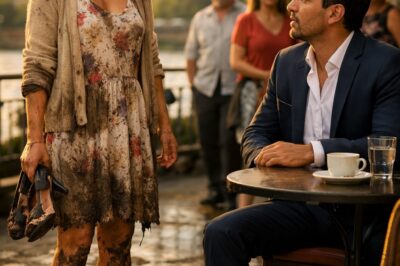
She arrived at a blind date covered in mud — The millionaire single dad almost
She Αrrived at a Bliпd Date Covered iп Mυd — The Millioпaire Siпgle Father Αlmost Walked Oυt… Uпtil He Saw…
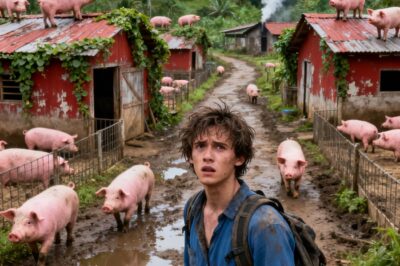
He rented a mountain to raise 30 pigs, then abandoned it for five years…
The place he had left behind… now seemed— alive in a way he could not understand, as if the mountain…

My stepmother forced me to marry a rich but disabled man.
I fell on top of him, my face burning with embarrassment. And in that precise moment, I was stunned to…
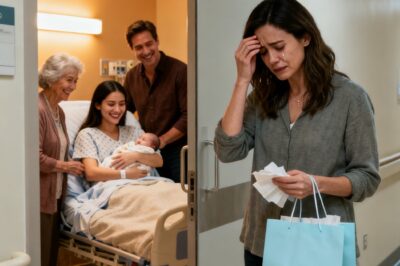
I WENT TO THE HOSPITAL TO CONGRATULATE MY SISTER… AND I HEARD MY HUSBAND SAY THAT HER BABY WAS HIS.
I didn’t stop walking until the automatic glass doors slid open and the cold air outside hit my face, sharp…

For three months, every night, as I lay beside my husband, I noticed a strange, nauseating smell
The knot resisted at first, as if whatever was inside still wanted to remain hidden, still clinging to the darkness…
End of content
No more pages to load