“I only have one year left to live… Marry me, give me an heir and you’ll have EVERYTHING!” said the farmer.

In 1878, the San Miguel Valley—nestled between blue mountains and mesquite-covered hills—awoke to the scent of damp earth and wild lavender. In a small adobe house on the edge of the old royal road, Catalina opened her eyes before the sun touched the crooked roof tiles. She was twenty years old and had the hands of a seamstress: calloused, precise fingers, capable of transforming a scrap of fabric into a promise.
At that hour, the world still held secrets in the folds of the mist. Catalina lit the oil lamp, adjusted her shawl, and bent over the dress she was mending for Doña Mariana, the lady of a large house in the north. Each stitch was an act of resistance. Each knot, a small victory against the hunger that stalked like a scruffy dog.
From the back room came the cough: harsh, wet, as if the night were breaking in someone’s throat.
Catalina put down the needle and walked barefoot across the packed earth floor. Aunt Mercedes sat on the bed, pale, pressing a handkerchief to her lips. When she lowered it, a red thread stained the fabric.
“Don’t get up, Auntie,” Catalina whispered, tucking her in. “Not today.”
Mercedes looked at her with eyes that were still bright and intelligent. She had been a teacher before she fell ill. And she had also been a mother when Catalina was left alone: cholera took her parents in a single summer week, and Mercedes picked her up like one picks up a seed from the dust.
“I’m fine, girl…” she lied, as she always did.
The traveling doctor who came by months ago spoke of “chest problems” and “weakness,” without giving it a specific name. But he did put a price tag on it: the syrups, the pills brought from Puebla, the visits… they cost more than Catalina earned sewing for entire seasons.
That morning she continued with her rituals: she heated mint tea, sliced the bread thinly so it would last all week, fed the chickens, and watered the pumpkin and cabbage patch. Then she went back to dressing. Sometimes she glanced up at the road, watching carts pass by with lives that seemed to belong to another world.
At dusk, when the golden light turned the dust in the air into a constellation, Catalina thought what she already knew: Mercedes’s medicine was running out. A week, maybe two. After that… nothing.
That night she wrote in a worn notebook hidden under her mattress. Mercedes said that writing was a way to keep the soul from rotting in silence. Catalina wrote about fear, about that helplessness that seeps into your bones when you love someone and have no way to save them.
He didn’t know—how could he know?—that the wind that came down from the largest estate in the valley also carried his destiny, folded like a letter.
At the Valverde Hacienda, half a league from the town, Don Agustín Valverde walked alone along stone walkways. It was almost ten o’clock, and the silence was heavy with mourning. Since his wife died five years ago, the house had become a shell: tidy, enormous, empty.
Agustín was forty-two years old, with the broad shoulders of a countryman and gray eyes that held an ancient sadness. His marriage to Carmela had been arranged: a union of surnames, land, and convenience. They lived like polite strangers. When she died of typhoid fever, he didn’t weep for love, but for the emptiness in his own life.
And in another, more ferocious word: childless.
His cousin Rodolfo Valverde, a gambler and burdened with debt, awaited that inheritance like a patient vulture. Everyone knew it: if Rodolfo took the hacienda, he would sell cattle, crops, the workers’ houses… everything, just to pay for gambling and bars.
Three weeks earlier, the regional doctor, Enrique Tovar, had confirmed the worst: “Your liver is in bad shape, Don Agustín… if it doesn’t improve, there won’t be much time left.” He spoke of eight to ten months, perhaps less. Agustín felt that death had already set a date at his doorstep.
Then the idea was born, terrible and practical: I needed an heir. Fast. No courtship. No parties. No years.
He looked at several women in the valley, but none of them fit the bill. He didn’t want a young lady from her social class, with demanding and bargaining families. He wanted someone with dignity and genuine kindness; someone who could raise a child with love, not with the coldness of protocol.
And then he saw Catalina, when she was temporarily helping in the kitchen during some repairs in the barns. He saw her work without complaint, speak respectfully to everyone, and—a detail that shook him to his core—he saw her read a piece of paper that the governess had left on the table. She wasn’t just deciphering letters: she understood.
Agustín asked discreet questions. He learned about the sick aunt. He learned about the poverty without complaining. Above all, he learned about an honesty that cannot be bought.
That night, with a trembling hand, he wrote a letter with his seal.
And she sent it.
The letter arrived one day in late May, when the dew still glistened on the leaves in the orchard. Catalina heard hooves before she saw the horse. The messenger, young and polite, handed her a thick envelope, sealed with a V.
“The answer should be in by noon tomorrow,” he said. “Don Agustín requests an audience.”
Catalina held him like a wounded animal. Mercedes watched her from her rocking chair, as if she already knew that this piece of paper was going to cause trouble.
The next day, Catalina put on her best blue dress, the one Mercedes had sewn for her two years before. She walked to the hacienda with her heart pounding in her chest.
In the office, Don Agustín was standing by the window. When he turned around, Catalina saw what she had only sensed before: the slight yellowing of his skin, the weariness in his eyes.
“Miss Catalina… Thank you for coming. I’ll be direct.” He sat down and took a deep breath. “I’m sick. And I have no heirs. If I die, Rodolfo will inherit this and destroy it. My workers… their families… will be left with nothing.”
Catalina swallowed, motionless.
“I need a son. A legitimate heir. And that’s why…”—the word weighed heavily on him—”I want to ask you to marry me.”
The silence became a wall.
“In exchange,” Agustín continued, looking at her intently, “your aunt will receive immediate treatment, a real doctor, city medicine. You will have a home, security forever. I won’t lie to you: it’s an agreement. A contract. But it will be legal and it will protect you.”
Catalina felt the world tilting.
“Why me…?” he managed to say.
“Because I saw her reading. And because I’ve asked about you. She’s not looking for handouts, but she knows the value of life. And…” she lowered her voice, “I need someone to raise a child with heart.”
He gave her the terms in writing. One week to respond.
Catalina left crying, not out of weakness, but because of the blow of the impossible.
She didn’t sleep that night. On the third day, Mercedes had a crisis. Blood on her handkerchief, blue lips, wild eyes. Catalina held her with trembling hands until her breathing returned as if death had taken a step back.
When Mercedes finally fell asleep, Catalina went to the door and looked indifferently at the stars.
“Life presents us with choices where there is no good option,” he recalled. Only the least cruel one.
The next morning he returned to the hacienda.
“I accept,” Catalina said firmly, “but with conditions: the doctor will see my aunt today. He will live near me. And I want access to his books… I want to learn.”
Agustín looked at her as if he truly respected her for the first time.
—It will be as you ask.
The agreement was sealed without a kiss, without flowers.
And yet, fate was already sewing something else with those cold threads.
The wedding was discreet, held in the village chapel. Only the priest, the corporal Sebastián, the governess Doña Eulalia, and the notary were present. Catalina answered “yes” as if signing a death warrant. Agustín did too.
At the hacienda, the days were silent. At dinner, the long table separated them like a river. At night, Agustín would knock on her door with a painful timidity. Catalina learned to breathe deeply and stare at the ceiling, to keep her word without breaking inside.
But the change came from where he least expected it: the library.
One afternoon Catalina came in, and the smell of leather and old paper seemed like a temple to her. She took a book of poems and sat down to read. When Agustín appeared behind her, he didn’t scold her.
—Do you like poetry?
Catalina was startled.
—Sorry… I…
“I said it was yours.” She stepped closer and looked at the book. “Good taste. Who taught you?”
—My aunt Mercedes. She used to say that reading is like having wings.
Agustín nodded.
—If you want, I can teach you accounting, contracts… If my time is short, you will have to know how to handle this for the child.
That night, for the first time, Catalina saw the man behind the boss: a teacher, someone who looked at her as a person and not as an instrument.
The lessons began after dinner. Catalina absorbed numbers, maps, agreements with suppliers, crop rotation. And, without realizing it, something inside her straightened: a new woman was being born alongside the agreement.
In September, Dr. Tovar confirmed the inevitable:
—She’s pregnant, Mrs. Valverde.
Catalina wanted to tell Agustín in private. At dinner, with the candles flickering, she did.
Augustine dropped his fork and covered his face. When he looked up, he had tears in his eyes that didn’t look like those of a powerful man, but rather like those of someone who had been saved.
“Thank you…” she whispered, resting her forehead on her stomach. “Thank God.”
Catalina felt compassion first… and then something more like tenderness.
With the pregnancy, Agustín became more attentive. He had better pillows brought in, more nutritious food. He accompanied her to the rose garden that Carmela had planted. One afternoon he spoke of his first, cold marriage, as if he could finally acknowledge his own loneliness.
“Things started badly between us,” he admitted, “but with you there’s life in this house. There’s conversation…” He looked at her, “and there’s something I didn’t expect: I care about you.”
Catalina felt that her heart, that stubborn muscle, was beginning to learn.
Then November arrived, and with it, horror.
Agustín’s condition suddenly worsened. It wasn’t a slow decline: it was a precipice. Vomiting, sharp pain, dizziness. Dr. Tovar frowned.
—This… doesn’t look like what I saw before.
One night, Catalina went down to the kitchen for water and found Rodolfo in the pantry. Her cousin smiled with serpentine teeth.
—You came up so fast, little seamstress.
Catalina felt cold.
—What are you doing here?
“I’ve only come to visit my cousin…” Rodolfo said, looking up. “Poor thing. So sick.”
Eulalia appeared behind him, like a stern shadow. Rodolfo left without saying goodbye, leaving a strange, metallic smell in the air.
That same morning, Catalina heard footsteps in the office. She went downstairs with a lamp and found Rodolfo rummaging through the chest where Agustín kept documents.
“Stop!” she said, her voice trembling but firm. “What are you doing?”
Rodolfo turned around with a twisted face.
—Getting rid of the trash. That will is worthless.
He tried to move forward. Catalina didn’t move.
“If he takes one more step, I’ll scream. Sebastian will throw him out of the ranch.”
Rodolfo stood still, assessing her as a new enemy.
—I thought you were docile.
—He thought wrong.
Rodolfo smiled, but his eyes promised war.
When Dr. Tovar arrived at dawn, Catalina told him about the papers, the pantry, and the metallic smell. The doctor remained silent, then asked to see the bottles of tonics that Agustín was taking.
She sniffed them. She tasted a drop with the tip of her tongue and spat it out.
“God help us…” he murmured. “This isn’t medicine. This is poison.”
The word fell like a stone.
—Rodolfo…? —Catalina couldn’t finish.
“I can’t say for sure yet,” the doctor said, “but there are signs of arsenic. In the city, they use hydrated iron oxide as an antidote. I’ll do my best… and you, ma’am, don’t leave anyone alone near your husband.”
That night they set a trap. Eulalia pretended to leave the “new” tonic in the kitchen. Sebastián hid with two farmhands behind the barn. Catalina, her heart in her throat, waited in the dark hallway.
Rodolfo appeared like a cat accustomed to stealing. He took the jar, removed a small packet, and silently emptied it. At that moment, Sebastián left.
—Now, you bastard!
Rodolfo tried to run, but the farmhands tackled him. Catalina approached, trembling, the lamp illuminating the dust.
“Why…?” he asked, more out of a need to understand than out of curiosity.
Rodolfo spat on the ground.
—Because that estate should be mine. Mine! And you… you are nothing.
“I am Agustín Valverde’s wife,” Catalina said, with a calmness she hadn’t known she possessed. “And I am the mother of his child. And you have just gone to confession.”
Rodolfo paled when he realized.
Dr. Tovar signed a report. Sebastián took Rodolfo to the district judge with the jar and the small packet as evidence. The news spread like wildfire through the valley.
Meanwhile, the antidote—crude, urgent, almost miraculous—began to work. Agustín didn’t heal overnight, but he stopped falling. His skin lost some of the yellowing. The pains became less severe.
One afternoon, with Catalina sitting next to his bed, Agustín opened his eyes and looked at her as if he had returned from a distant place.
“You… saved me,” she whispered.
Catalina squeezed his hand.
—He taught me to read the world. I wasn’t going to let them rip it away.
Agustín closed his eyes, and a single tear crossed his temple.
“When I proposed this to you… I thought it was the end. And it turns out…” he breathed, “…it was the beginning.”
In January, on a cold morning with the valley covered in frost, Catalina went into labor. Mercedes, already feeling better thanks to the medicine, became like a rock: she held her, calmed her, and prayed. Eulalia organized everyone with the discipline of a general.
Agustín insisted on staying close, even though the doctor told him to rest. When the baby’s cries finally filled the house like a bell, Agustín burst into tears without shame.
“He’s a boy,” said Mercedes, with a wet smile. “Strong.”
—Gabriel Agustín Valverde— whispered Catalina, kissing his small forehead. —Welcome.
Agustín entered the room leaning on Sebastián. Catalina, exhausted, lifted the baby so he could see him. Agustín touched Gabriel’s cheek with trembling fingers. The child, as if he understood, remained still.
“Forgive me,” Agustín said, looking at Catalina. “For how it all started. For the cold. For… not giving you flowers.”
Catalina swallowed a sob.
—We don’t choose how things come to us. We choose what we do with them.
Agustín looked at her for a long time, as if he were really seeing her for the first time.
—Then I choose this: if life grants me more time… I want a real marriage. Not by contract. For love.
Catalina felt that, at last, her heart was surrendering.
—Yes —she whispered—. That I do choose.
Rodolfo was convicted of attempted murder and fraud. He wasn’t hanged—Mexico was already beginning to change its punishments—but he was sent far away to forced labor on a hacienda in the south. The valley forgot him as cowards are forgotten.
The Valverde Estate, on the other hand, flourished.
In time, Dr. Tovar explained what everyone feared and hoped for: Agustín’s liver disease was not an inevitable death sentence, but rather the damage caused by the poison—repeated, patient, and cruel. With rest, a special diet, and months of care, Agustín regained his strength.
In spring, when the maguey plants provided shade and the air smelled of fresh earth, Agustín asked the priest at the chapel to marry them again. This time there were flowers. This time there was violin music. This time the long table was filled with people: farmhands, cooks, children from the orchard, neighbors from the valley. Mercedes wept as if she were seeing a circle come full circle.
Catherine put on a simple white dress, sewn by herself. It wasn’t luxury: it was a symbol. It was dignity.
—I, Agustín —he said, in a firm voice—, choose you, Catalina, not out of necessity, but because my life is better with you.
—And I choose you —she replied—, not out of fear, but because I learned that love is also sewn: stitch by stitch.
There was a kiss, at last. One that wasn’t bound by any contract.
Years later, Catalina would write in her notebook, with Gabriel playing in the yard and Agustín checking accounts beside her: “Destiny tried to tear everything away from us with poison and ambition. But it didn’t count on how stubborn a heart can be when it decides to stay.”
They built a small school on the hacienda for the workers’ children. A dispensary where Dr. Tovar came every month. Agustín, who had previously feared dying without a legacy, saw something better: not just an heir, but a family—and a community—that breathed justice.
And in the afternoons, when the sun fell on the Valley of San Miguel and the lavender swayed like a purple sea, Catalina would sit on the veranda with Gabriel in her arms, Mercedes beside her and Agustín behind, resting his hands on the shoulders of both women.
Sometimes life begins as a cold agreement.
And sometimes, if one dares to sew with patience, it ends up as what it should always have been: a home full of light.
News
My husband yelled at me on the phone: ‘Grab the girl and run now!’ — Ten minutes later, the police surrounded the entire house
GET OUT OF THERE RIGHT NOW My husband called me suddenly and asked, bluntly:“Where are you right now?” I was…
The day I buried my husband, I also buried the weak woman I was… and the secret hidden in the stone wall since 1962 began to awaken.
I’ll never forget the smell of that day, because some smells cling to your soul forever. It smelled of earth…
The day my three children sold the house and threw this old couple out onto the street with nothing but a little goat… was also the day the secret hidden in the old suitcase began to come to light.
Elena López held little Blanquita to her chest, a bundle of warmth and trembling amidst the chill that had settled…
I was hugging my daughter’s grave when I heard a whisper: “Dad… they’re already talking about your funeral.”
The cold stone beneath my knees was the only thing keeping me tethered to reality, though, to be honest, reality…
They called me ‘the crazy widow’ for building a wall… until the sky turned black and fear gripped everyone
My name is Margarita Torres. In the town of San Isidro, nestled in the foothills of the Sierra Madre Occidental,…
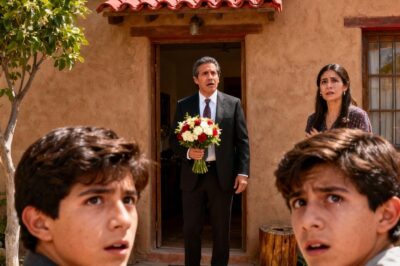
A millionaire returns after 17 years… and is shocked to discover his wife has two children…
Alejandro Torres gripped the steering wheel as if he could stop time. His imported car gleamed too brightly in front…
End of content
No more pages to load