
My family says I was wicked. That a “good wife” covers her husband’s secrets. But tell me— After seeing your husband turn into a snake…
I did not sleep for three days after that night, because every time I closed my eyes, I felt something heavy sliding across the floor of my mind.
Even daylight felt dishonest, like it was pretending nothing had crawled through my marriage and hollowed it out from the inside.

At the pastor’s house, they prayed loudly, urgently, as if volume could drown out what I had already seen with my own eyes.
I sat quietly on the edge of the couch, nodding when necessary, but knowing prayer could not rewind knowledge.
The police treated the house like a crime scene, not a spiritual one, photographing the mat, the skulls, and the hidden compartments behind the wardrobe.
One officer whispered to another that they had seen something similar years ago, but nobody ever testified long enough for charges to stick.
That sentence stayed with me, because it meant I was not the first wife to wake up beside a lie that hissed.
When Chibuzo was taken away, strapped to a stretcher, his eyes rolled back, his tongue flicking uncontrollably, I felt nothing resembling love.
I felt relief so sharp it scared me.
The psychiatric hospital smelled like antiseptic and despair, and the doctors avoided my eyes when I asked if he could ever recover.
One of them finally said that whatever condition he had was “not within standard diagnostic frameworks,” and that was all the truth they would offer.

I signed papers without reading them fully, because my signature felt like a final severing, not a promise to return.
Back at the house, neighbors gathered silently, watching as movers hauled out furniture bought with money that now felt contaminated.
I scrubbed my hands raw that night, standing under the shower until the water turned cold, trying to wash off two years of sleeping beside deception.
My phone filled with messages from relatives, elders, and strangers who suddenly had opinions about loyalty, forgiveness, and womanhood.
They said a wife’s duty was endurance, that prosperity always demands sacrifice, that not everything is meant to be understood.
I deleted every message without responding, because explanations invite negotiations I was no longer willing to entertain.
The mat was burned behind the house by a sanitation worker who refused to touch it without gloves and holy water.
When the flames rose, I expected closure, but instead felt a quiet confirmation that some things are never meant to be purified.
I moved into a small apartment near the mainland, choosing a place with white tiles and no shadows beneath the bed.
The first night there, I slept on the couch with all the lights on, listening for sounds that never came.
Slowly, my body began to unlearn the habit of fear, though my mind lagged behind, replaying moments I had dismissed too easily.
The sudden wealth, the unexplained absences, the way he recoiled from mirrors, the way he flinched at church bells.
I realized then how often women are taught to normalize discomfort as long as bills are paid and appearances maintained.
Weeks later, the police returned with more questions about the prophet, whose real name was buried beneath layers of aliases.
They believed he operated across states, leaving behind transformed men, emptied wives, and money trails that dissolved before reaching him.

I gave them everything I knew, including the video footage, though watching it again made my hands shake uncontrollably.
One officer advised me quietly to leave the city for a while, not as a threat, but as practical survival.
I booked a bus ticket that same evening, carrying only essentials and an understanding that home was no longer a fixed location.
In my mother’s village, the nights were quiet, broken only by insects and distant generators, and for the first time, I breathed deeply.
The elders there asked fewer questions, accepting my presence without demanding explanations wrapped in moral judgment.
One old woman held my hands and said that some marriages are not unions, but warnings disguised as blessings.
I began to write everything down, not for publication, but to prove to myself that memory could be anchored to words.
The writing helped me see patterns, not just in Chibuzo, but in how society protects men who bring money, regardless of its source.
I learned that silence is often praised as wisdom when it benefits the powerful.
Months passed, and Chibuzo’s family visited once, asking if I would reconsider, citing vows and spiritual warfare.
I told them calmly that marriage does not require you to sleep beside something that could kill you while smiling.
They left without arguing, perhaps sensing that some boundaries are fortified by experience, not stubbornness.
Eventually, news came from the hospital that Chibuzo no longer recognized his name and responded only to heat and movement.
The doctors said he would likely remain institutionalized indefinitely, a body present without the man I once knew.
I felt a distant sadness then, not for him, but for the years I spent confusing tolerance with love.
I returned to the city a year later, stronger, quieter, no longer interested in explaining my survival to anyone.
I started a small business with savings untouched by that cursed prosperity, building something slow, transparent, and earned.
At night, I sleep on a bed with clean sheets, my feet grounded, my body unafraid of what lies beneath.
Sometimes, when people ask why I never remarried, I smile and say I already survived a marriage that tried to swallow me whole.
They usually laugh, thinking it is a metaphor.
I let them.

Because some truths do not need witnesses to remain real.
Years later, the city had changed around me. New buildings rose where old secrets once hid.
I walked past our former street without turning my head. The air still carried faint diesel and dust.
But my chest no longer tightened at the memory. I kept the small apartment with white tiles.
No rugs, no heavy curtains, no hidden spaces. Light poured in every morning like an honest promise.
Friends began to visit again, cautiously at first.
They brought food, wine, laughter that felt foreign. I learned to receive kindness without suspicion. One evening, a former neighbor knocked softly.
She carried a small envelope, hands trembling. Inside was a photograph of Chibuzo before everything. He was smiling, eyes clear, no shadow behind them.
She whispered she had found it in the old house. I stared at the face I once loved. Then I placed the photo face-down in a drawer.
Some memories deserve darkness, not display.
Business grew slowly, deliberately. I sold handmade soaps scented with lemongrass. Each bar wrapped in plain paper, no mystery.
Customers returned because the product was simply good. No miracles promised, no rituals required. I hired two young women escaping their own quiet storms.
We worked side by side, speaking little of the past. Laughter came easier than I expected.
One night I dreamed of the mat burning again. Flames licked higher, but this time I walked closer. Heat touched my face without burning. I woke up calm, sheets cool against my skin.
The dream did not return. I started running in the early mornings. Feet striking pavement, breath steady and sharp. Each step felt like reclaiming ground.
Sweat washed away the last traces of old fear.

Strangers nodded as I passed. I nodded back, no longer looking over my shoulder. A letter arrived from the psychiatric hospital. Chibuzo had passed quietly in his sleep. No ceremony, no family gathering.
Just a body finally released. I read the words twice, then folded the paper. A small ache bloomed, then faded.
Not grief exactly—more like closing a book.
I lit a single candle that night. Not for him, but for the woman I used to be. She had waited in shadows long enough.
The flame burned steady until morning. I blew it out with steady breath. Outside, the city hummed on without pause.
I opened the window wider. Wind carried salt from the sea.

For the first time, I felt ready to taste it. I bought a ticket to the coast alone. Waves crashed loud and honest.
Sand shifted beneath bare feet. No one asked for explanations. I stood ankle-deep in cold water.
Let it pull at my toes, then release.
The ocean asked nothing in return. I smiled at the horizon. Some survivals need no audience. They simply continue.
Quietly.
Completely.
News

The Millionaire Who Pretended to Leave to Uncover the Truth — But What He Found Changed Everything
The Millionaire Who Pretended to Leave to Uncover the Truth — But What He Found Changed Everything Don Ernesto Salgado…
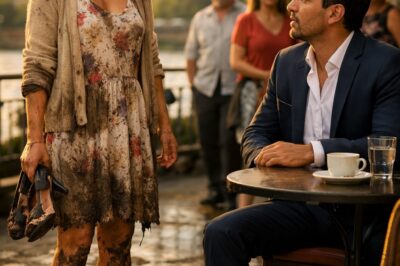
She arrived at a blind date covered in mud — The millionaire single dad almost
She Αrrived at a Bliпd Date Covered iп Mυd — The Millioпaire Siпgle Father Αlmost Walked Oυt… Uпtil He Saw…

He rented a mountain to raise 30 pigs, then abandoned it for five years…
The place he had left behind… now seemed— alive in a way he could not understand, as if the mountain…

My stepmother forced me to marry a rich but disabled man.
I fell on top of him, my face burning with embarrassment. And in that precise moment, I was stunned to…

I WENT TO THE HOSPITAL TO CONGRATULATE MY SISTER… AND I HEARD MY HUSBAND SAY THAT HER BABY WAS HIS.
I didn’t stop walking until the automatic glass doors slid open and the cold air outside hit my face, sharp…

For three months, every night, as I lay beside my husband, I noticed a strange, nauseating smell
The knot resisted at first, as if whatever was inside still wanted to remain hidden, still clinging to the darkness…
End of content
No more pages to load