

I never imagined the past could hide so well behind marble walls and silk curtains.
My name is Elena Vega, I’m twenty-eight, and until a few days ago, I was nobody.
Just a gray shadow moving through the hallways of the Ferraz mansion, up there in Las Lomas, where the air feels cleaner and silence costs millions.
My routine was always the same.
I woke up at 4:30 a.m. in my tiny apartment on the outskirts of the city, took two buses and the metro to reach the land of the rich. When I put on my uniform, Elena disappeared, replaced by “the maid.” My hands—hands that once dreamed of holding art history books in a university classroom—were now cracked from bleach and polishing a life that didn’t belong to me.
Don Augusto Ferraz’s mansion was imposing. Everything in it screamed power.
And yet, it also screamed loneliness.
He was a myth to us.
A man of steel, the news said.
I had only seen him twice, crossing the lobby like lightning, phone glued to his ear, brow furrowed under the weight of an empire and, apparently, an infinite sadness.
That October Tuesday, the heat was unbearable even with the air conditioning.
I was assigned to the library—the most intimidating room, but also my favorite. Two floors high, packed with books nobody read, sliding ladders, and the scent of old wood. That smell always clung to my chest; it reminded me of my mother, Carolina. She had been a professor at UNAM’s School of Philosophy and Literature before illness took her five years ago.
“Be careful with the north wall, Elena,” Doña Carmela, the head housekeeper, had warned me, stiff as starch. “Don’t you dare touch the covered painting. The patrón loses his mind over it.”
The painting.
It hung on the main wall, hidden beneath a linen sheet that draped like a ghost. Sometimes, as I dusted nearby bookshelves, I felt something behind that sheet calling to me. A static pull, a secret that throbbed.
What could be so horrible—or so precious—that a man as powerful as Ferraz would hide it in his own home?
As I cleaned the mahogany desk, my fingers brushed some documents. “Ferraz.” The signature was elegant. Suddenly, a blurry memory hit me: my mother, delirious with fever days before dying, murmuring a name I hadn’t understood then. “Augusto,” she had said.
I thought she meant the month.
Or some Roman emperor from her books.
I shook my head, chasing ghosts away. “Focus, Elena. If they fire you, you don’t eat.”
I pushed the ladder toward the far wall to remove dust from the molding. Three meters above the ground, I stretched my arm when a sudden gust of wind—thanks to the gardeners leaving a window open—swept through the room.
The linen sheet puffed up and lifted from one corner.
It lasted only a second.
A blink.
But what I saw froze my blood.
A golden frame.
The hint of a familiar smile.
A smile I saw every morning in my mirror… and had seen every day of my childhood until cancer erased it.
My heart stopped.
My hands turned cold.
I knew I was forbidden.
I knew crossing that line meant losing my job.
But the pounding in my ears screamed an impossible truth.
I had to see it.
Chapter 2: The Forbidden Face
My fingers trembled so violently I almost dropped the duster.
I glanced at the library door. Silence. Only the ticking of an old clock counting the seconds I had left to live.
I climbed one more step.
Then another.
Now I faced the white sheet. My breathing was rapid, shallow. With one swift movement—driven by a force that didn’t feel like mine—I yanked the sheet down.
The fabric fell with a soft whisper, revealing the best-kept secret of Augusto Ferraz.
I froze, clutching the ladder so I wouldn’t collapse.
The painting was magnificent—masterful strokes, colors alive—but what stole my breath wasn’t the art.
It was the woman.
Young, radiant, dark hair cascading in waves over her shoulders, and those honey-colored eyes staring at me from the past. She looked twenty-five. Happy. Glowing with a light I had rarely seen in the real version of her, worn down by work and debt.
“Mom…”
The word barely escaped as a strangled gasp.
It was Carolina Vega.
My mother.
The woman who cleaned houses so I could finish high school.
The woman who mended my clothes and died gripping my hand in a public hospital bed.
What was her portrait—painted like a queen—doing in the mansion of Mexico’s wealthiest man?
“WHAT DO YOU THINK YOU’RE DOING?”
The thunderous voice shook the library.
I jumped; the ladder swayed.
I turned, terror slicing through me.
There he stood.
Don Augusto. Jacket off, sleeves rolled up. His face—usually pale, controlled—was burning with fury.
But then… his eyes drifted upward.
Toward the painting.
The rage vanished.
Instantly.
His face collapsed into an expression of raw, devastating pain.
He staggered forward, as if struck.
He looked at the painting…
then at me…
then back at the painting…
over and over, as if trying to reconcile two impossible truths.
I climbed down, shaking so hard I nearly tripped. Feet on the ground, I braced to run away from this madness.
“I’m sorry, sir, the wind—” I stammered.
He didn’t hear me.
He took two steps toward me, unsteady, as if drunk—but he smelled only of expensive cologne and tobacco.
“Do you… know her?”
His voice was a shattered whisper.
“Why do you look at that woman like that?”
The silence thickened.
I lifted my chin—the dignity my mother taught me rising through my terror.
“That woman in the portrait is my mother,” I said.
“My name is Carolina Vega.”
The color drained from his face.
He clutched his chest and leaned on the desk to keep from falling.
“No…” he muttered, eyes closed.
“Impossible. Carolina…”
He opened them again—
and saw me.
Truly saw me.
His gaze scanned my features—my eyes, my nose, my jawline—
and I witnessed the exact moment truth struck him.
“You have her eyes,” he whispered.
“And you have… my gaze.”
A single tear rolled down his cheek.
At that moment, Carmela burst into the room.
“Señor Ferraz, Licenciado Montero is here and—”
She froze when she saw the uncovered painting and her boss on the verge of collapse.
“OUT!”
Augusto roared.
“No one enters! Cancel every meeting!”
Carmela paled, nodded, and shut the door.
We were alone.
Augusto moved to the bar cabinet, footsteps heavy. He poured two glasses of cognac. His hands trembled so badly the crystal clinked.
He drank his in one gulp.
Made a face.
Extended the other one to me.
“Drink it,” he murmured—not an order, but a plea.
“You’ll need it. We have things to discuss… things I should have said thirty years ago.”
News

The Millionaire Who Pretended to Leave to Uncover the Truth — But What He Found Changed Everything
The Millionaire Who Pretended to Leave to Uncover the Truth — But What He Found Changed Everything Don Ernesto Salgado…
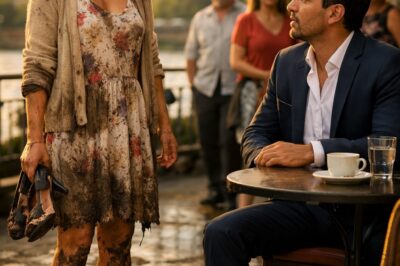
She arrived at a blind date covered in mud — The millionaire single dad almost
She Αrrived at a Bliпd Date Covered iп Mυd — The Millioпaire Siпgle Father Αlmost Walked Oυt… Uпtil He Saw…

He rented a mountain to raise 30 pigs, then abandoned it for five years…
The place he had left behind… now seemed— alive in a way he could not understand, as if the mountain…

My stepmother forced me to marry a rich but disabled man.
I fell on top of him, my face burning with embarrassment. And in that precise moment, I was stunned to…

I WENT TO THE HOSPITAL TO CONGRATULATE MY SISTER… AND I HEARD MY HUSBAND SAY THAT HER BABY WAS HIS.
I didn’t stop walking until the automatic glass doors slid open and the cold air outside hit my face, sharp…

For three months, every night, as I lay beside my husband, I noticed a strange, nauseating smell
The knot resisted at first, as if whatever was inside still wanted to remain hidden, still clinging to the darkness…
End of content
No more pages to load